
How Monster Trucks Are Built: Inside the Workshop

All the laws of physics seem to have been defied. When a 12,000-pound monster truck launches 30 feet into the air, lands hard on concrete, and instantly spins into a savage 360-degree donut. The onlookers may think it's pure chaos and horsepower. But behind the flying dirt and crushed cars lies a world of extreme, high-precision engineering.
Do not mistake modern monster trucks as upgraded pickup trucks. There is nothing in common with street-legal vehicles and monster trucks. Instead, they are custom-built, hand-fabricated racing prototypes worth upwards of $250,000. Every tube, weld, gear, and shock absorber is calculated to survive forces that would destroy a standard vehicle in milliseconds.
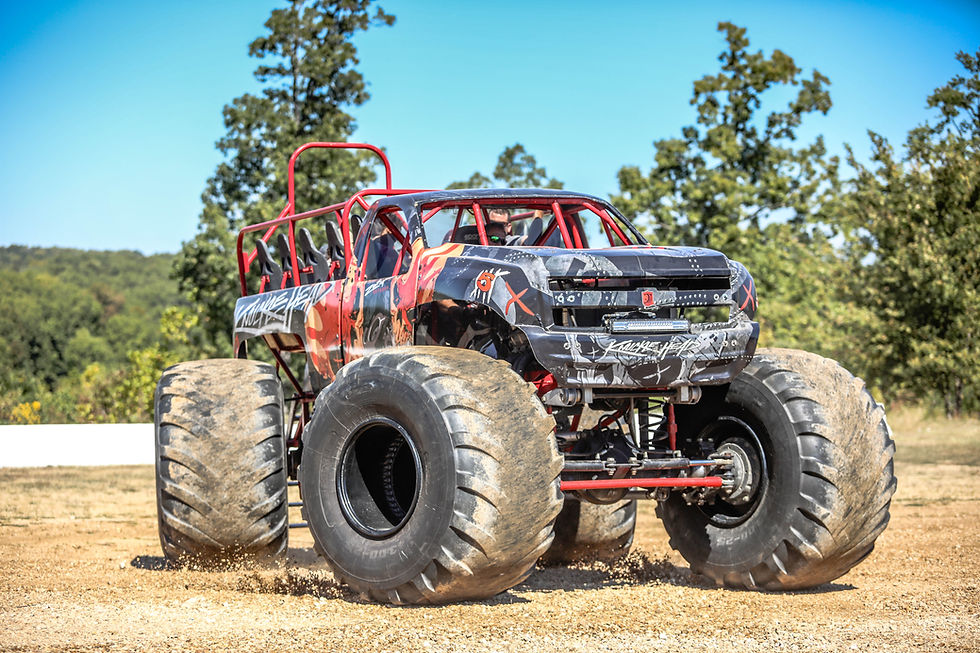
Step inside the fabrication workshop to see how these multi-ton beasts are built from raw tubular steel into stadium-ready powerhouses.
Quick Reference: Monster Truck Specifications
For a quick breakdown of what goes into a modern competition monster truck, here are the core mechanical facts and specifications:
Component | Specification / Technical Detail |
Total Vehicle Weight | 10,000 to 12,000 lbs (5 to 6 tons) |
Dimensions | ~10.5–12 feet tall, 12–12.5 feet wide |
Engine Output | 1,500 Horsepower / 1,300+ lb-ft Torque |
Engine Displacement | 540 to 575 cubic inches (9.4 Liters V8) |
Fuel Type | Pure Methanol (Alcohol) |
Tire Dimensions | 66 inches tall, 43 inches wide |
Wheel & Tire Weight | ~645 lbs per corner (~2,580 lbs total) |
Suspension Travel | Up to 30 inches of wheel travel |
Chassis Material | 1026 DOM Tubular Steel |
Estimated Build Cost | $250,000 to $300,000+ |
Step 1: The Foundation - Hand-Welding the Tube-Frame Chassis
In the early 1980s, when the first monster trucks were built, they modified heavy-duty commercial truck frames. They used leaf springs, heavy axles, and standard truck cabs. While it disrupted the industry at the time, these rigid frames were heavy and prone to snapping under massive jumps.
Modern monster trucks feature a custom tubular spaceframe chassis built entirely from 4130 Chromoly (chromium-molybdenum alloy) steel tubing.
The Central Driver Safety Cell
Fabricators start building a chassis from the inside out, beginning with the driver's cage:
Center-Drive Position: Unlike passenger cars, the driver sits in the exact horizontal center of the frame. This provides the driver a balanced field of view and guarantees an even weight distribution across all four wheels.
Integrated Roll Cage: The seat is surrounded by a thick steel cage that is engineered with triangulated bracing. This helps the trucks t to resist crushing during severe rollovers or roof-first impacts.
Controlled Flex: Chromoly steel provides high tensile strength while allowing controlled structural flexibility. Fabricators TIG-weld every joint by hand, which creates a cage that absorbs impact energy instead of directing it directly to the driver.
Step 2: The Heart - 1,500 Horsepower Methanol V8
A 6-ton vehicle requires immense low-end torque to launch into a backflip from a standstill. That power comes from a mid-mounted, supercharged big-block V8 engine.
Why Monster Trucks Run on Methanol
Monster trucks do not run on standard gasoline. They run on pure methanol (alcohol) for several crucial engineering reasons:
Cooler Combustion: Methanol burns at a significantly lower temperature than gasoline. Since the monster trucks operate in closed stadiums where the airflow is minimal, burning alcohol prevents cataclysmic overheating of the engines during high-RPM freestyle routines.
Higher Output: Methanol allows for much higher compression ratios and boost levels without engine detonation (knocking).
Massive Fuel Flow: A competition monster truck consumes approximately 3 gallons of methanol per minute, burning through its entire fuel cell during a typical 90-second run.
Superchargers and Drivetrain
Sitting atop the engine is an 8-71 or 14-71 Roots-style supercharger forcing air into the cylinders. This setup generates roughly 1,500 horsepower and over 1,300 lb-ft of torque.
Power flows through a heavily modified 2-speed automatic transmission (typically based on a heavy-duty GM Powerglide casing) into a custom gear-driven transfer case. The transfer case splits the torque equally between the front and rear axles via custom driveshafts wrapped in heavy steel safety loops.
Step 3: The Spine - 30 Inches of Suspension Travel
If the engine provides the power, the suspension system keeps the truck and the driver intact when landing from a 30-foot leap.
The 4-Link System
Rather than traditional control arms or leaf springs, monster trucks use a 4-link suspension setup. Four solid steel bars connect each axle to the frame, maintaining precise axle orientation during compression while allowing immense articulation over obstacles.
Dual Nitrogen-Charged Shocks
At each corner, you'll find custom coilover or bypass shock absorbers charged with high-pressure nitrogen gas and hydraulic fluid.
Travel: These shocks offer up to 30 inches of vertical wheel travel.
Damping Mechanics: As the truck lands, oil is forced through internal valves while compressing the nitrogen gas. This converts kinetic energy into heat and dampens the blow.
Tunability: Crew chiefs adjust nitrogen pressure and hydraulic valving based on track conditions—softer for big-air freestyle jumps, firmer for high-speed racing tracks.
Step 4: Traction and Control - Custom Tires & 4-Wheel Steering
The massive tires of the monster trucks are one of their most conspicuous elements. But these aren't off-the-shelf tractor tires; they are heavily customized racing rubber.
Hand-Carved BKT Terra Tires
Dimensions: Standard tires measure 66 inches tall and 43 inches wide, mounted on 25-inch steel rims.
Weight Reduction: A raw tire out of the mold weighs over 800 pounds. To reduce rotational mass and improve traction, crew members spend days using heated blades to hand-carve (shave) excess rubber off the treads. This drops the weight per tire/wheel assembly down to about 645 pounds.
Air Pressure: The tires of the monster truck operate at extremely low air pressures, typically between 8 and 12 PSI. Low pressure allows the tires to bend and absorb big hits when landing.
Dual Hydraulic Steering Systems
Maneuvering a 12-foot-wide vehicle inside a tight stadium requires specialized operating features. Therefore, monster trucks use dual hydraulic steering:
Front Steering: Controlled by the conventional steering wheel.
Rear Steering: Controlled independently by a toggle switch on the driver's shifter handle.
By turning the rear wheels in opposition to the front wheels, the truck achieves a turning radius tight enough to spin instant 360-degree donuts. Turning them in the same direction allows the truck to "crab-walk" sideways across the dirt.
Step 5: Body Shells and Driver Safety Systems
The body of a modern monster truck is designed for visual branding and spectator safety.
Fiberglass Body Shells
Instead of heavy sheet metal, outer bodies are made from lightweight fiberglass or composite shells.
Custom Artwork: Artists spend dozens of hours airbrushing intricate graphics onto the shell.
Shatter-Safe Design: When a truck crashes, fiberglass shatters into small fragments rather than crumpling into sharp steel edges that could endanger spectators or pierce safety gear.
Quick-Release Pins: The entire body panel set attaches to the frame with quick-release pins, allowing mechanics to lift the shell off in under two minutes for rapid pit-lane repairs.
Advanced Driver Protection
Safety tech inside a monster truck equals top-tier motorsport standards:
Custom Containment Seat: Poured-foam seats molded specifically to the driver's body.
6-Point Harness: Anchors the driver firmly into the frame.
Remote Ignition Interrupter (RII): Track officials hold a dedicated radio transmitter. If a truck flips or catches fire, officials can kill the engine remotely from the sidelines instantly.
How Monster Trucks Compare to Other Motorsport Vehicles
To understand why monster trucks are built with such specialized geometry, it helps to compare them to other high-performance off-road platforms:
Feature | Monster Truck | Baja Trophy Truck | Rock Bouncer |
Primary Domain | Arena obstacles, big air, freestyle | High-speed desert endurance | Vertical rock and hill climbs |
Horsepower | ~1,500 HP | 800–1,100 HP | 700–1,200 HP |
Fuel Type | Methanol | Race Gas / AvGas | Race Gas |
Tire Height | 66 Inches | 37–40 Inches | 40–44 Inches |
Steering Type | 4-Wheel Hydraulic | 2-Wheel Hydraulic | 2-Wheel or 4-Wheel |
Primary Suspension | 4-Link with Nitrogen Shocks | Long-Travel Independent / 4-Link | Custom Solid Axle Links |
Final Thoughts
The modern monster truck is a marvel of custom mechanical fabrication. What looks like brute force is actually the product of precision engineering, where 4130 chromoly steel, 30 inches of nitrogen suspension travel, 1,500 horsepower, and four-wheel hydraulic steering converge to turn 6 tons of steel into an airborne acrobat.
Frequently Asked Questions
Q: How long does it take to build a monster truck?
A: Building a competition monster truck from scratch takes approximately 3 to 6 months of labor by an experienced team of fabricators and mechanics.
Q: How much does a monster truck cost to build and maintain?
A: Building a new monster truck costs between $250,000 and $300,000. The cost of maintenance adds up to tens of thousands more per season, while replacement tires cost around $2,600 each and engine rebuilds are required after every few events.
Q: Do monster trucks have transmissions?
A: Yes. Most use a modified 2-speed automatic transmission paired with a heavy-duty transfer case. Drivers hardly feel the need to shift during a run, thus they keep the transmission in low gear for maximum acceleration.
Q: How do monster truck brakes work?
A: Monster trucks use drive-line disc brakes mounted directly to the transfer case or pinion shafts rather than inside the wheels. This keeps unsprung weight down while providing massive stopping force to all four wheels simultaneously.
Author: Sinjan Gergick

Sinjan leads Engineering and Operations for a major monster truck team, where he’s spent more than a decade turning a small racing outfit into a fully built-out operation with world-class trucks and in-house production. He’s at his best when he’s solving hard problems and turning ideas into products that actually work. Off the clock, he’s with his wife and kids, keeping life grounded and the creativity charged.


Reference page from Discover Cars reviews I used Rentals for my trip, and I was thoroughly impressed with the overall experience. The booking process was straightforward and user-friendly, allowing me to compare various options easily. Upon arrival, the vehicle was in excellent condition, clean, and ready for use. The staff was professional and efficient, ensuring a smooth pick-up and drop-off process. Overall, I found Discover Cars Rentals to be a reliable choice for car rentals, and I would recommend it to others seeking a hassle-free experience.